The knee has a unique structure, which is also the reason behind uncomplicated treatment procedures. Even their simple activity of walking, climbing stairs, and sitting properly all become a daunting task. However, for many people—especially those who have significant damage to the joints, when other treatments do not work, Knee Replacement Surgery in Ahmedabad is the answer. However, one question that many patients are asking is whether they need a total knee replacement or a partial knee replacement. Differentiating one from the other can initiate an intentional approach.
What Is Knee Replacement Surgery?
Knee replacement surgery is a procedure involving the replacement of the degenerate parts of the knee joint with artificial prosthetic components. They are neighbours here and there, so their parts can slide through each other comfortably enough to reduce pain. The surgery is typically recommended when the knee joint suffers serious damage because of things like osteoarthritis, injury or chronic wear and tear.
The knee joint is made up of three main compartments:
- Inner (medial)
- Outer (lateral)
- Front (patellofemoral)
Depending on how much of the knee is damaged, the doctor may suggest either a total or partial replacement.
What Is Total Knee Replacement?
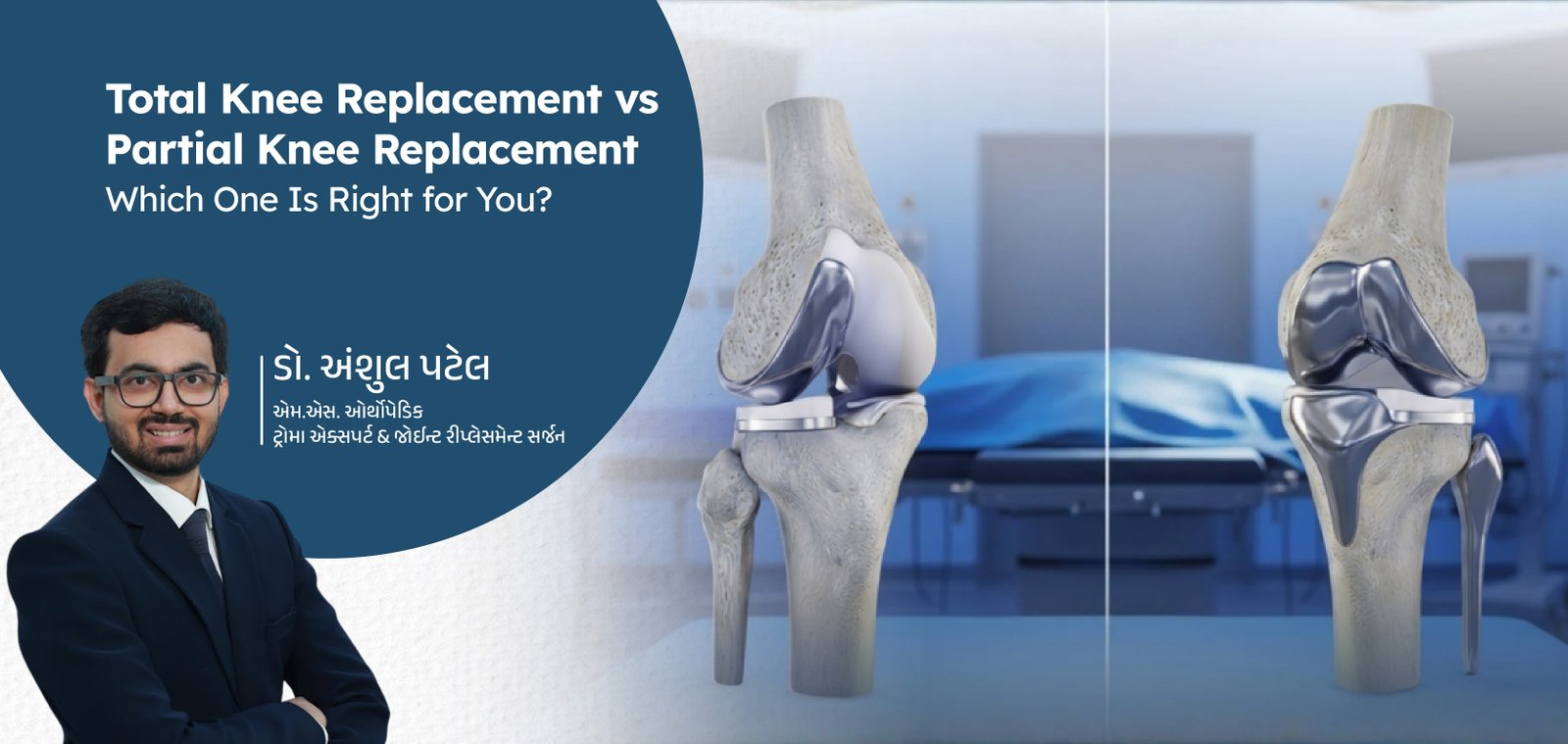
Total knee replacement (TKR) is a surgical procedure in which all three compartments of the knee joint are replaced. During this process, the worn-out cartilage and bone are removed and replaced with metal and plastic parts.
When Is It Recommended?
Total knee replacement is subsequently advised by the doctors when:
- It damages the entire knee joint
- Pain is severe and constant
- Daily activities are limited
- Non-surgical treatments no longer work
How It Works
During the surgery:
- The surgeon cleans away damaged bone and cartilage
- Components are attached to the leg bone , shin bone and sometimes the kneecap
- These pieces will assist the joint in moving easily again
Recovery
Recovery may take a few weeks to a few months. Physiotherapy plays an important role in regaining strength and movement.
What Is Partial Knee Replacement?
Partial knee replacement (PKR) is also called unicompartmental knee replacement. In this procedure, only the damaged part of the knee is replaced, while the healthy parts are left untouched.
When Is It Recommended?
Partial knee replacement may be suitable if:
- Damage is limited to one part of the knee
- Ligaments in the knee are still strong
- The patient has a good range of motion
- The knee is stable
How It Works
In this surgery:
- Only the affected compartment is treated
- The rest of the knee structure remains natural
- A smaller implant is used compared to total replacement
Recovery
Recovery is usually faster than total knee replacement. Patients may experience less pain after surgery and return to normal activities sooner.
Key Differences Between Total and Partial Knee Replacement
Extent of Surgery
Total knee replacement covers the entire joint, while partial replacement focuses only on the damaged area.
Surgical Procedure
Partial knee replacement is less invasive. It involves a smaller incision and less removal of bone.
Recovery Time
Partial replacement often allows quicker recovery. Total replacement may need more time and rehabilitation.
Movement and Feel
Some patients feel that partial knee replacement gives a more natural movement because most of the knee remains unchanged.
Durability
Total knee replacements are generally considered more suitable for long-term use, especially when damage is widespread.
Benefits and Limitations
Total Knee Replacement
Benefits:
- Suitable for severe damage
- Long-lasting results in many cases
Limitations:
- Longer recovery time
- More invasive procedure
Partial Knee Replacement
Benefits:
- Smaller surgery
- Faster recovery
- More natural knee movement
Limitations:
- Not suitable for all patients
- May require revision if damage spreads
Understanding the Decision
It is important to understand that both surgeries aim to reduce pain and improve movement. The choice between them depends on medical evaluation rather than personal preference alone.
Patients considering Knee Replacement surgery in Ahmedabad should discuss all options with a qualified
Conclusion
When the pain in the knee is persistent and impacts life, then knee replacement surgery will help improve the quality of life. Total and partial knee replacements are two different types of procedures; they perform the same thing but in different scenarios. Total knee replacement is an option when there is widespread damage, but partial knee replacement only replaces one part of the knee.
A better understanding of the distinctions, advantages, and drawbacks of the various procedures may help patients have more confidence in their treatment plan. The most crucial step in determining what surgery is appropriate continues to be a complete medical evaluation. And for this, you can visit Krishna Hospital or directly contact them by calling on the number 7575010050.